
English
Governance Overview
DotOne is designed to move from foundation-led operation toward DAO-controlled governance as the network matures (see Governance and DAO Framework in the whitepaper). This page covers how that governance process is meant to work in practice: who can propose changes, how voting works, and what happens once a proposal passes.
Voting Power
One staked DOTO gets you one vote — no quadratic scaling, no extra weight for locking up longer. Here's how it actually works: stake DOTO with a validator and you get an equal amount of non-transferable staking credit back, and it's that credit, not the DOTO itself, that carries your voting weight. Staking by itself doesn't turn your voting power on, though — you still have to delegate it, either to yourself, to your validator, or to someone else you trust to vote for you.
Because validator staking supports delegation, this isn't limited to validators — any DOTO holder who stakes, whether directly or by delegating to a validator, picks up their own proportional voting weight, along with:
- The right to submit and vote on proposals
- Continued staking rewards while a proposal they've backed is in the voting period
- The option to delegate their voting power to a validator or another trusted party, without giving up custody of their DOTO
Workflow
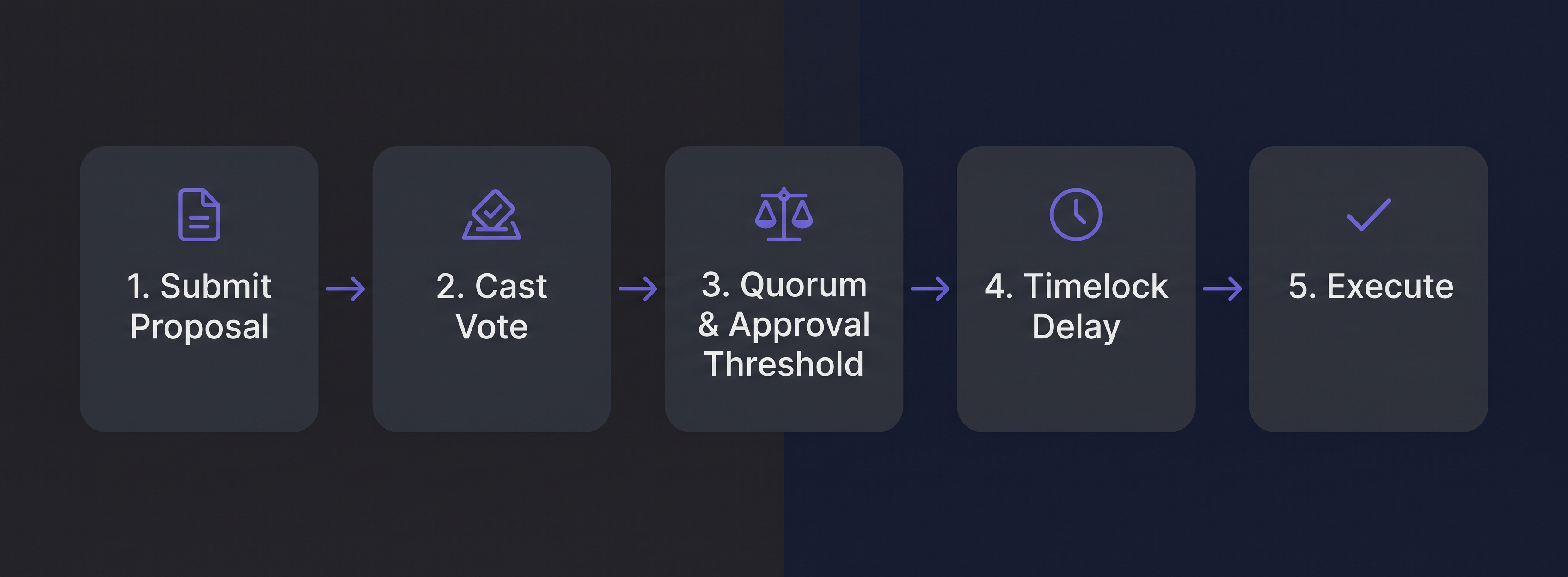
1. Submit Proposal — A staking-credit holder above a governance-defined minimum threshold submits a proposal specifying its target contracts/parameters and the change being requested. Only one active proposal per proposer is allowed at a time, to prevent spam.
2. Cast Vote — Once a proposal enters its voting window, staking-credit holders (or their delegates) vote for or against it. Voting power is snapshotted at proposal submission, so acquiring stake after a proposal is live does not grant additional voting weight for it.
3. Execute Proposal — A proposal only executes if it clears both a minimum participation threshold (quorum) and a majority approval threshold. Passed proposals go through a timelock delay before execution, giving the community a final window to react before changes take effect.
Exact thresholds (minimum stake to propose, voting period length, quorum, and timelock duration) are governance-configurable parameters — they are expected to be set conservatively at launch and revisited by the DAO as participation grows, rather than fixed permanently in this document.
Delegation of Voting Power
Not every staking-credit holder wants to research and vote on every proposal. DotOne governance supports delegating voting power to:
- A validator you already trust with your stake
- A community delegate or professional governance-participation service
Delegation does not move or lock your DOTO — you keep full custody and can re-delegate or vote directly at any time. It exists purely to let passive holders stay represented without requiring active participation in every vote.
Scope of Governance
Per the whitepaper's governance framework, DAO governance is intended to progressively take control over:
- Treasury spending (grants, liquidity incentives, validator rewards, reserves)
- Validator policy (reward parameters, admission rules, performance requirements)
- Burn policy (real-time burn ratio, periodic burn formula)
- Protocol upgrades (EVM upgrades, hard forks, infrastructure changes)
- RWA policy (issuer standards, compliance framework, approved asset categories)
Early on, the DotOne Foundation retains multisig control over the most safety-critical functions, and hands that control to the DAO as the process matures — see the User Guide for how to actually submit and vote on a proposal.