
English
Whitepaper
Important Notice and Disclaimer
This whitepaper is a technical, economic and product design document for DotOne Smart Chain. It is not a securities prospectus, investment advice, legal advice, tax advice, or a guarantee of future network performance. Product features, governance parameters, release dates, bridge phases, validator policies and token utility are subject to implementation, audit, compliance review, market conditions and governance approval.
DOTO is described as the native coin of DotOne Smart Chain. Its intended utility includes gas payment, validator staking, governance participation and ecosystem incentives. Any sale, distribution, listing, custody, or use of DOTO must be evaluated under applicable laws and jurisdiction-specific requirements.
DotOne Smart Chain is inspired by the operating logic of high-performance EVM networks such as BNB Smart Chain, especially fast finality, EVM tooling, low fees and validator-based operation. DotOne is not BNB Smart Chain and does not inherit BNB Chain governance, validator policy, emissions, bridge architecture or security guarantees.
1. Executive Summary
DotOne Smart Chain is a public, EVM-compatible Layer-1 blockchain designed for decentralized finance, real-world asset tokenization and enterprise Web3 infrastructure. The chain uses the DOTO native coin, Chain ID 505, 18 decimals, a 3-second target block time and Proof of Stake consensus. The total and maximum supply are both fixed at 100,000,000,000 DOTO, minting is disabled and inflation is set to 0%.
The network follows a BSC-inspired design philosophy: fast block production, EVM compatibility, low-friction wallet integration, validator-based operations, native gas fees and a broad application ecosystem. DotOne adapts this design for its own economic model: delegated staking with direct validator accountability, a fee-and-commission validator reward model with no fixed treasury emission, DAO-controlled burn parameters and an RWA-first product strategy.
The ecosystem consists of DotOne Smart Chain as the base layer, dotscan.one as the explorer, bridge.dotone.online as the bridge interface, swap.dotone.online as a custom-developed DEX, wizard.dotone.online as a no-code issuance platform and multiple RPC endpoints for redundancy. The long-term target is to become a multi-chain settlement and asset issuance ecosystem serving DeFi users, enterprises, institutions, token issuers, validators and developers.
Component Status
This whitepaper describes some components that are live today and others that are still being built or are only planned. To avoid the ambiguity of language like "should" or "aims to" without a status attached, every component in this document falls into exactly one of three states, and each major section below states which status applies to what it describes:
- Live / Implemented — deployed and operating today, usable by real users.
- In Development — actively being built; architecture and rules described here are the design target, not yet fully operating in production.
- Planned — on the roadmap, not yet built; numbers given are illustrative design targets for governance to ratify, not commitments.
| Component | Status | Notes |
|---|---|---|
| Mainnet | Live / Implemented | Running now, Chain ID 505, DOTO as the native coin |
| Testnet | Coming Soon — In Development | Not up yet, faucet included — see Faucet for details |
| Public RPC endpoints | Live / Implemented | Set up your wallet or client using the API Reference and JSON-RPC pages |
| Explorer (dotscan.one) | Live / Implemented | You can look up transactions, addresses, and blocks right now |
| DotOne Swap | Live / Implemented | A working DEX, trade at swap.dotone.online |
| DotOne Wizard | Live / Implemented | Go to wizard.dotone.online and create your own token, no coding needed |
| Bridge — Phase 1 (BNB Chain) | Live / Implemented | Bridging to and from BNB Chain works today — see Bridge and Cross-Chain Strategy |
| Bridge — Phase 2+ (Ethereum, Polygon, Arbitrum, Solana) | Planned | No fixed date — each phase opens once it clears security review |
| Validator set (10 → 100+) | Live / In Development | 10 validators are securing the network now, more are being onboarded toward 100+ |
| Governance / DAO module | In Development | The foundation's multisig still handles critical decisions until the DAO tooling is ready — see Governance |
| RWA tokenization module | Planned | See RWA Tokenization Framework |
2. Market Context and Opportunity
The blockchain market is moving beyond simple token transfers and toward application-specific settlement, tokenized assets, institutional custody, on-chain collateral and cross-chain liquidity. Developers prefer EVM-compatible environments because existing Solidity tooling, wallets, indexers and audit practices reduce time to market. Enterprises prefer infrastructure that is predictable, documented, secure and compatible with compliance workflows.
Real-world asset tokenization is a major opportunity because assets such as real estate, commodities, bonds, precious metals, receivables and enterprise instruments can benefit from programmable settlement, fractional access, digital transferability and transparent ownership records. However, these assets require legal structures, custody arrangements, issuer disclosures and jurisdiction-specific controls.
DotOne positions itself at the intersection of high-performance EVM execution and compliance-aware RWA infrastructure. The opportunity is to provide a chain where DeFi liquidity, tokenized assets and enterprise tools are designed together rather than added as disconnected products.
3. Design Principles
DotOne is designed around six principles: EVM compatibility, predictable monetary policy, validator accountability, governance transparency, RWA readiness and infrastructure reliability. These principles guide protocol design, product roadmap, treasury use and ecosystem development.
BSC-inspired architecture is used because BSC demonstrated that users and developers value fast transactions, familiar tooling and low fees. DotOne preserves those advantages while using its own Proof of Stake model, fixed supply and fee-and-commission validator reward structure. The aim is to provide BSC-like usability without copying BSC governance, validator economics or supply design.
Every major network parameter should have an owner and a governance path. Examples include burn ratios, treasury spending, validator rewards, bridge limits, grant programs, RWA issuer requirements and upgrade schedules. This makes the network adaptable while maintaining auditability and community oversight.
4. Network Specification
DotOne Smart Chain is a public Layer-1 blockchain. The execution environment is EVM compatible, allowing Solidity smart contracts and Ethereum-style wallets to interact with the network. The native coin is DotOne Coin, symbol DOTO, and the chain is identified by Chain ID 505.
DOTO is the gas asset for transactions and the primary economic coordination unit for validators, governance and ecosystem programs. The supply model is intentionally non-inflationary: maximum supply equals total supply, minting is disabled and inflation is 0%.
The launch design targets a 3-second block time, 10 initial validators and expansion to more than 100 validators within three years. Validator admission, security requirements and reward rules should be documented and governed before mainnet launch.
| Parameter | Specification |
|---|---|
| Network Name | DotOne Smart Chain |
| Network Symbol | DOTO |
| Native Coin | DotOne Coin |
| Coin Symbol | DOTO |
| Chain ID | 505 |
| Consensus | Proof of Stake |
| Blockchain Type | Public Layer 1 |
| Virtual Machine | EVM Compatible |
| Block Time | 3 seconds |
| Decimals | 18 |
| Total Supply | 100,000,000,000 DOTO |
| Maximum Supply | 100,000,000,000 DOTO |
| Inflation | 0% |
| Minting | Disabled |
5. System Architecture
The system architecture separates execution, consensus, governance, products, infrastructure and cross-chain services. This separation makes it easier to audit responsibilities, assign ownership and scale the network safely. The execution layer handles state transitions, EVM calls, smart contract deployment and gas accounting. The consensus layer coordinates validators and block production. The product layer includes Swap, Wizard and RWA tooling. The infrastructure layer includes explorer, RPC, APIs and monitoring.
The architecture intentionally avoids unnecessary complexity at launch. The first mainnet objective is reliability: stable RPC endpoints, accurate explorer indexing, validator uptime, secure treasury management and safe bridge activation. Advanced scaling, cross-chain liquidity and institutional features can be staged after the base network is stable.
The design also supports future modular upgrades. Governance can approve upgrades to fee routing, burn parameters, bridge integrations, validator rules, governance contracts, RWA modules and developer tooling without changing the core economic identity of DOTO.
Request Flow
The layered view above groups responsibilities; this is the actual path a transaction takes end-to-end, and where the surrounding services attach to it:
Wallet / DApp
     │  signed tx
     ▼
   RPC  ───────────────────────────────► Indexer / Explorer
     │  broadcast                              ▲
     ▼                                          │ reads finalized state
  Mempool                                       │
     │  block proposal                          │
     ▼                                          │
 Consensus (validator election, voting) ────────┘
     │  elected proposer produces block
     ▼
  Validator (executes block)
     │  state transition
     ▼
   State (world state, storage trie)

Attached services (each calls the chain through the same RPC layer,
not through a private path):
  Bridge      → locks/mints assets via bridge contracts, reads State for proofs
  Oracle      → pushes external price/data feeds into State for contracts to read
  Governance  → proposal/vote/execute contracts, timelocked writes to State
  Treasury    → multisig/DAO-controlled contract, reads fee flow, writes reward payouts
  DEX (Swap)  → ordinary contract on Execution, no special chain-level privileges
  Wizard      → deploys asset contracts through the same RPC/Execution path
Everything below "Wallet / DApp" is chain infrastructure; everything in the "Attached services" block is a smart-contract-level participant that talks to the chain the same way any other contract or dApp does — none of them have privileged access to consensus or state outside of what their own contract logic and governance-approved permissions allow.
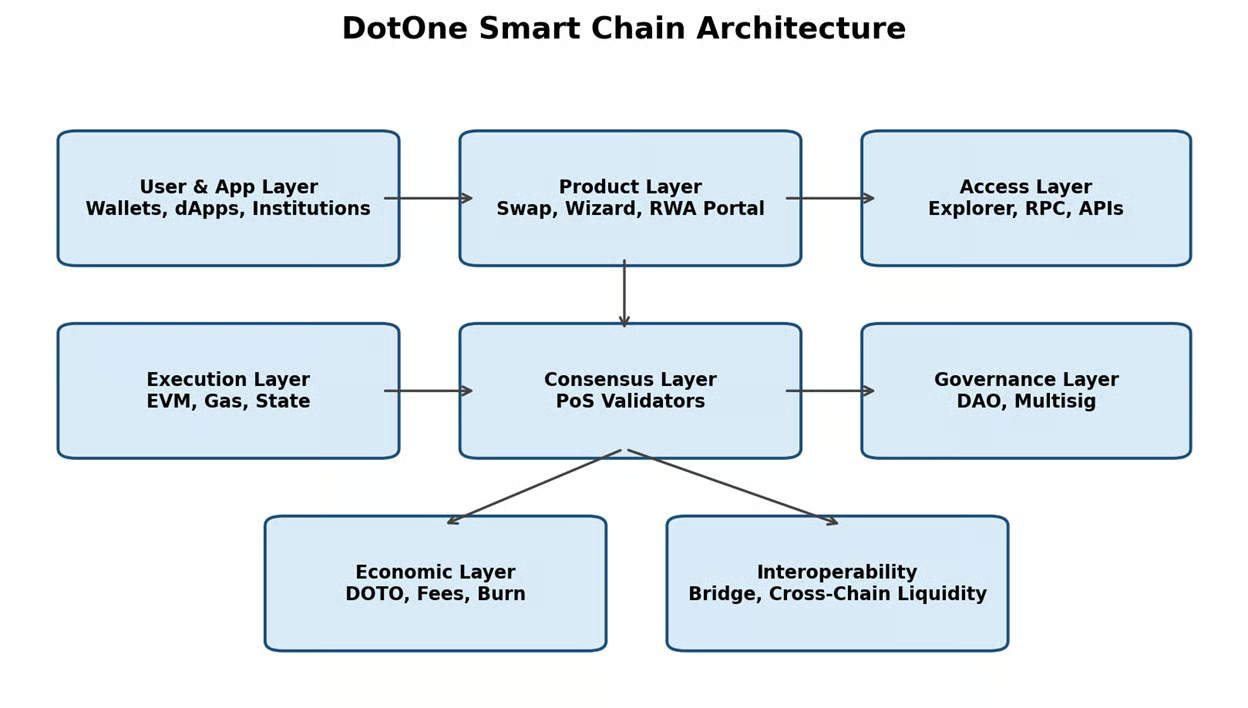
Figure 2. DotOne layered network architecture.
| Layer | Primary Responsibility | Launch Requirement |
|---|---|---|
| Execution | EVM execution, gas accounting, state transitions | Solidity contract support and reliable transaction processing |
| Consensus | Validator coordination and block production | 10 initial validators and uptime monitoring |
| Governance | DAO proposals, treasury and parameter control | Multisig launch controls and DAO roadmap |
| Product | Swap, Wizard, RWA modules | Audited templates and documented interfaces |
| Infrastructure | RPC, explorer, APIs, monitoring | Public endpoints, status monitoring and indexer support |
| Cross-Chain | Bridge integrations and liquidity routing | Security-gated bridge phases |
6. EVM Compatibility and Developer Tooling
EVM compatibility allows DotOne to support Solidity contracts, ERC-style assets, MetaMask integration, Hardhat, Foundry, Remix, contract verification, block explorers and common indexing tools. This is critical for developer adoption because it reduces migration cost from Ethereum and BSC-style networks.
DotOne should expose public RPC endpoints, archive services for indexers, WebSocket endpoints where needed, testnet faucets, contract verification, chain metadata, and clear developer documentation. The developer experience should include copy-paste examples for adding the chain to wallets, deploying contracts, verifying code and interacting with the bridge and swap.
The network should maintain compatibility with common token standards including ERC-20-style fungible tokens, ERC-721 NFTs and ERC-1155 multi-token assets. Stablecoins and RWA assets require additional issuer controls, compliance modules and transfer restrictions where applicable.
7. Consensus and Validator Model
DotOne uses Proof of Stake with delegated validator staking, similar in structure to BSC. The initial validator set is 10 and the target is more than 100 validators within three years. Minimum validator self-stake is 200,000,000 DOTO. DOTO holders can delegate stake to a validator of their choice, and validators remain directly accountable for their own stake, uptime and operational security regardless of how much delegated stake they attract.
Consensus Implementation
Status: Live / Implemented
The consensus engine is Proof of Staked Authority (PoSA) running on the Parlia engine, derived directly from BNB Smart Chain's code and go-ethereum's architecture. The active validator set is determined by stake and DotOne's own validator-election rules, and block production rotates among that set on a fixed schedule; behavior outside protocol rules can be met with slashing or temporary removal from the active set.
Finality works by quorum certificate: a vote is valid once at least ⌈2N/3⌉ of the active validator set — two-thirds, rounded up — has signed off on it (as a generic example unrelated to DotOne's current validator count: a set of 21 active validators would need at least 14 valid votes). This gives fast, deterministic finality instead of the probabilistic confirmation-depth model Ethereum uses.
Validator selection happens through a daily election after 00:00 UTC that ranks active validators by staked amount. The top of that ranking becomes Cabinets (more likely to be picked each epoch), and the rest of the active validators become Candidates (lower odds per epoch) — the full mechanism is covered in Validator Election & Consensus. This ranking is recomputed every cycle, so a validator that misses the active set one day isn't removed permanently, just left waiting for the next election.
Jailing and slashing both exist and are already live. Miss your block-production duty, go offline past the downtime threshold, or drop below the minimum self-delegation, and you get jailed — temporarily excluded from consensus until you submit an unjail transaction once the waiting period passes (see Slash Monitor). Double-signing or a malicious vote is treated more seriously: stake gets slashed on top of the jail time, and repeat offenses escalate the penalty. The full breakdown is in Slashing Overview and Slash Rules.
Validators earn their share of transaction fees plus commission on delegator rewards — there is no treasury-funded block reward. Because DOTO has no inflation and minting is disabled, this fee-and-commission model is the network's only source of validator income, which is exactly why network usage and delegated stake matter so much to long-term validator sustainability.
Validator Economics
Status: Live / Implemented — the mechanism below is how validator income actually works today, not a projection
DotOne does not pay a fixed or predetermined reward per block. Following the same structure as BSC, a validator's income comes from two sources: its share of the transaction fees collected in the blocks it produces, and the commission it earns on the rewards of any delegators who have staked DOTO with it. There is no separate treasury-funded block reward in the network's economic model — validator income scales with actual network usage (fees) and with how much stake, including delegated stake, a validator has attracted, not with a fixed emission schedule.
This means validator returns aren't something we can quote as a flat APY — they depend on transaction volume and total delegated stake, both of which are expected to grow as the network does, and both of which are outside any single fixed parameter governance would need to tune.
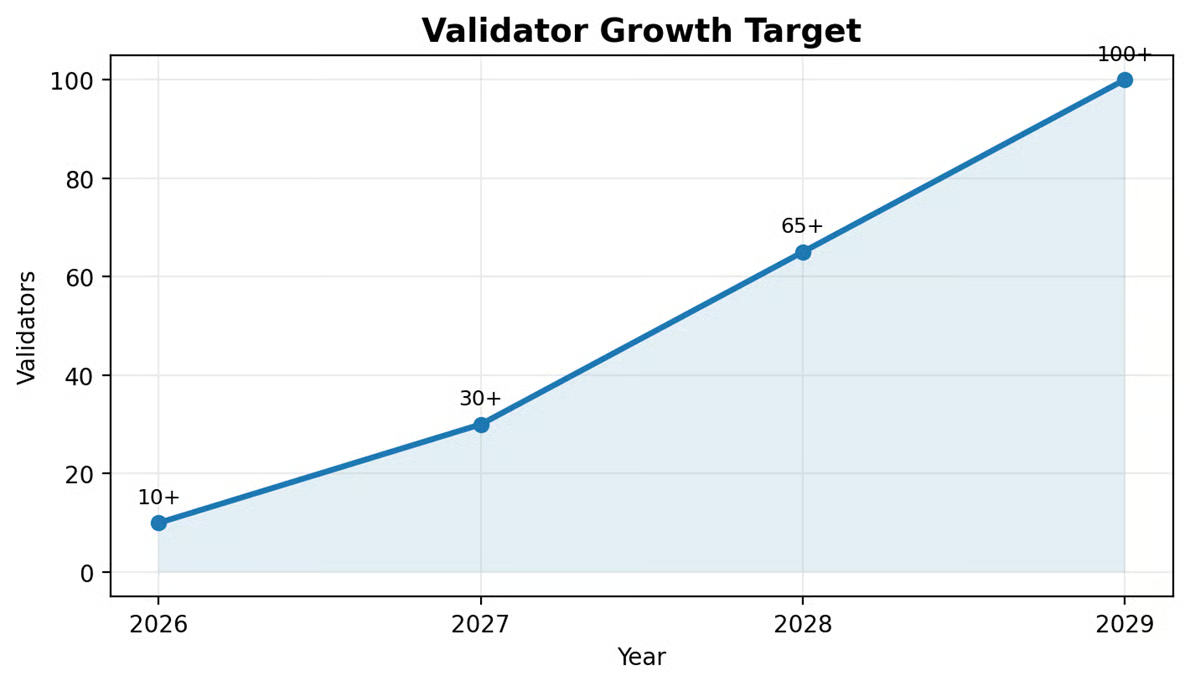
Figure 3. Validator growth target from launch to 2029.
| Validator Topic | Specification / Policy |
|---|---|
| Initial Set | 10 validators |
| Three-Year Target | 100+ validators |
| Minimum Stake | 200,000,000 DOTO |
| Delegation | Supported — DOTO holders can delegate stake to a validator |
| Rewards | Share of transaction fees plus commission on delegator rewards; no fixed treasury block reward |
| Performance Focus | Uptime, block production, security hardening and monitoring |
| Lifecycle Stage | Description |
|---|---|
| Candidate Review | Infrastructure, security and stake readiness assessed before admission |
| Activation | Validator joins consensus set after meeting stake and operational requirements |
| Monitoring | Uptime, missed blocks, latency and incidents tracked continuously |
| Incentives | Fee share and delegator commission, distributed per protocol rules |
| Discipline | Downtime or security failures handled by documented policy |
| Exit | Validator retirement or removal follows governance and operational procedures |
8. Tokenomics and Vesting
Status: Planned — illustrative model; final parameters require governance/foundation ratification before TGE
DOTO tokenomics are based on a fixed supply of 100,000,000,000 DOTO. Allocation is split across public sale, validator and system development, founder, marketing and treasury. Validator and System Development is a combined 15% allocation, equal to 15,000,000,000 DOTO. The large public sale allocation supports broad distribution, while treasury and marketing allocations support ecosystem growth.
Because there is no inflation, supply-side discipline depends entirely on vesting, treasury controls, liquidity program design and burn mechanisms. This structure can support long-term scarcity, but it also requires careful liquidity management so network growth is not constrained by insufficient circulating DOTO.

Figure 4. DOTO allocation model.
| Allocation | Percentage | Token Amount |
|---|---|---|
| Public Sale | 60% | 60,000,000,000 DOTO |
| Validator and System Development | 15% | 15,000,000,000 DOTO |
| Founder | 15% | 15,000,000,000 DOTO |
| Marketing | 5% | 5,000,000,000 DOTO |
| Treasury | 5% | 5,000,000,000 DOTO |
Vesting Schedule
Public Sale, Validator and System Development, Marketing and Treasury are 100% unlocked at TGE and have no lock or vesting schedule. The entire 15,000,000,000 DOTO Validator and System Development allocation is available from the beginning.
Only the Founder allocation is locked. Its 15,000,000,000 DOTO starts with 0% unlocked at TGE and is released every nine months in eight tranches: 5%, 5%, 5%, 10%, 15%, 15%, 20% and 25%. Each percentage is calculated against the Founder's allocation, not the total DOTO supply or the remaining locked balance. The first 5% unlocks in month 9; the final 25% unlocks in month 72.
| Allocation | Initial Unlock (TGE) | First Post-TGE Release | Release Window | Release Cadence |
|---|---|---|---|---|
| Public Sale | 100% | Not applicable | None | Fully unlocked at TGE |
| Validator and System Development | 100% | Not applicable | None | Fully unlocked at TGE |
| Founder | 0% | Month 9 | 72 months | Every 9 months: 5%, 5%, 5%, 10%, 15%, 15%, 20%, 25% |
| Marketing | 100% | Not applicable | None | Fully unlocked at TGE |
| Treasury | 100% | Not applicable | None | Fully unlocked at TGE |
Founder Release Schedule
The eight releases below total 100% of the 15,000,000,000 DOTO Founder allocation. No Founder tokens are unlocked before month 9.
| Release Time | Share of Founder Allocation | DOTO Released | Cumulative Unlocked |
|---|---|---|---|
| Month 9 | 5% | 750,000,000 DOTO | 5% |
| Month 18 | 5% | 750,000,000 DOTO | 10% |
| Month 27 | 5% | 750,000,000 DOTO | 15% |
| Month 36 | 10% | 1,500,000,000 DOTO | 25% |
| Month 45 | 15% | 2,250,000,000 DOTO | 40% |
| Month 54 | 15% | 2,250,000,000 DOTO | 55% |
| Month 63 | 20% | 3,000,000,000 DOTO | 75% |
| Month 72 | 25% | 3,750,000,000 DOTO | 100% |
| Total | 100% | 15,000,000,000 DOTO | 100% |
The Founder vesting contract should be audited, public, and designed to minimize discretionary release risk. Release events should be visible on the explorer and included in governance or foundation reporting.
9. Gas, Fees and Burn Mechanisms
DOTO is used to pay gas fees. Fee design should prioritize predictability, low cost and validator sustainability. DotOne can use BSC-inspired fee logic while defining its own gas price policy, congestion rules and burn split. The fee router should account for validator compensation, real-time burn and treasury-related policy.
DotOne uses two burn concepts: real-time burn inspired by BEP-95 and periodic auto burn inspired by BNB Auto-Burn. The real-time burn mechanism can burn a DAO-defined portion of transaction fees. The periodic auto burn mechanism can execute scheduled burns based on DAO-approved parameters.
Burn governance must balance scarcity and security. Excessive burn may harm validator incentives or liquidity. Insufficient burn may weaken the economic narrative. DAO controls should include burn ratio, burn cadence, minimum and maximum thresholds, emergency pause and reporting requirements.
Dual Burn — How It Works
Status: Planned — the mechanism is set, exact parameters (K, execution frequency, supply floor) are still to be finalized by governance
DotOne's burn design mirrors BSC's dual-burn structure, but the two mechanisms are independent of each other and work differently from a flat "burn X% of revenue" rule:
1. Real-time burn (per block, automatic, BEP-95-style): a percentage of the gas fee that's subject to burning is sent to an irrecoverable address immediately, in every block — with the initial rate set at 10% of the gas fee subject to burning (not 10% of "base fee" — that distinction matters and should stay precise in any documentation). The remaining 90% flows into the reward cycle for validators and delegators. This ratio is a governance-adjustable parameter, not fixed forever.
2. Periodic Auto-Burn (independent of BEP-95, executed on a recurring schedule): unlike a simple percentage of quarterly revenue, the burn amount is computed from the number of blocks produced, the average market price of DOTO, and a governance-set policy coefficient:
B = N / (100 × P) × KWhere B is the amount of DOTO to burn, N is the number of blocks produced in the period, P is the average DOTO price over that period, and K is a monetary-policy adjustment coefficient set by DotOne governance. A quarter's auto-burn is not a fixed percentage of fee revenue — it scales with real network activity (block count) and current market price, and Auto-Burn execution stops once circulating supply reaches a governance-defined target floor, rather than running against a fixed quarterly cap. The value of K, how often the burn executes, and the exact supply floor are all parameters that governance and monetary policy still need to finalize before this goes live.
Together, the two mechanisms tie burn to actual usage and market conditions rather than to an arbitrary marketing percentage — a quiet period burns less, an active one burns more, and the model has a built-in stopping point once the network reaches its target supply floor.
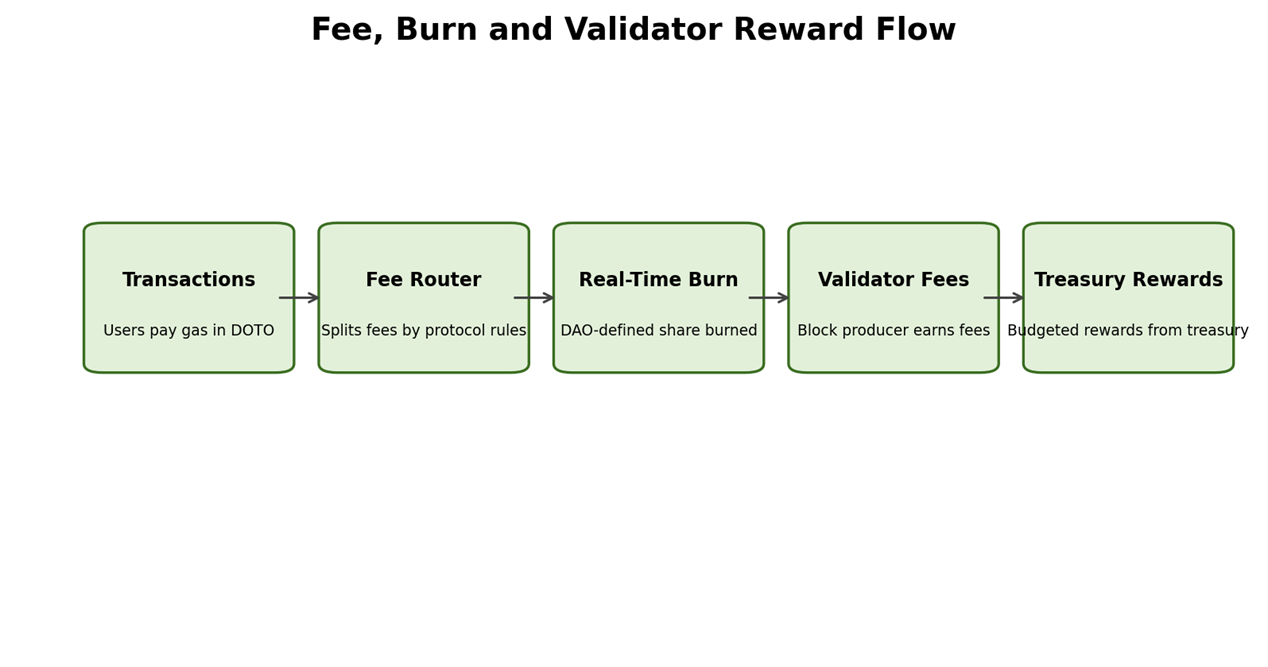
Figure 5. DOTO fee, burn and reward flow.
| Mechanism | Purpose | Governance Controls |
|---|---|---|
| Real-Time Burn | Burn a portion of the gas fee subject to burning, every block | Burn ratio and emergency pause |
| Periodic Auto Burn | Scheduled burn tied to blocks produced and DOTO price | Coefficient (K), execution cadence, supply floor |
| Validator Fee Share | Compensate validators for block production | Fee split, reward policy and performance requirements |
| Validator Commission | Compensate validators from their delegators' staking rewards | Commission rate set per-validator, within protocol limits |
10. Treasury and Sustainability
The treasury allocation is 5% of total DOTO supply and is managed by the DotOne Foundation through a 3-of-5 multisig at launch. Treasury use cases include validator rewards, ecosystem grants, liquidity incentives, strategic investments, community development and emergency reserves.
Treasury sustainability is essential because validator rewards partly depend on treasury support and there is no inflation. Treasury budgeting should be staged by phase: launch support, liquidity bootstrapping, developer grants, RWA onboarding, bridge security and long-term reserves. DAO governance should gradually take more control over treasury policy.
Treasury transparency should include wallet visibility, proposal records, grant reporting, incentive program outcomes and periodic financial summaries. Large treasury actions should require clear justification, risk review, voting and execution delays.
| Treasury Use Case | Description | Control |
|---|---|---|
| Validator Rewards | Support validator economics during early growth | Budgeted by foundation/DAO |
| Ecosystem Grants | Fund tooling, applications, audits and integrations | Proposal and milestone review |
| Liquidity Incentives | Bootstrap DOTO pairs and strategic assets | Time-bounded programs |
| Strategic Investments | Partnerships and enterprise adoption | Governance approval |
| Community Development | Education, events and governance support | Transparent reporting |
| Emergency Reserves | Incident response and operational continuity | Restricted use policy |
Treasury Economics
Status: Planned — the framing below (no fixed subsidy obligation) is settled; specific reserve amounts and budget terms are not
Because DotOne has no fixed per-block treasury reward, the Treasury does not carry a standing obligation to subsidize validators at any set rate. Under normal conditions, network security is funded by transaction fee revenue, staking, and validator commissions — the same fee-and-commission model described in Validator Economics — not by a fixed treasury payout.
That said, part of the Treasury can still serve as a network bootstrap reserve: temporary validator incentives during early growth, attracting professional node operators, infrastructure development, staking program support, and offsetting low fee income in the network's early stages. The size and duration of this support should be set through time-bound budgets and governance approvals rather than a permanent earmark — there is no fixed 2B DOTO (or any other amount) committed to this purpose. Any specific reserve figure quoted elsewhere should be read as a revisable budget ceiling, not a locked-in treasury obligation.
11. Governance and DAO Framework
Status: In Development — see Component Status
DAO governance includes validators and DOTO holders. Governance controls treasury spending, validator rewards, burn parameters, protocol upgrades, ecosystem grants and strategic investments. This makes governance the central coordination layer for DotOne economic and technical evolution.
Voting Power
Voting power works the same way it does on BNB Smart Chain's governance module: one staked DOTO is one vote, with no quadratic scaling and no boost for locking up longer. When you stake DOTO with a validator, you get an equal amount of non-transferable staking credit in return, and it's that credit — not the DOTO itself — that actually carries your voting weight. Staking alone doesn't switch your voting power on, though; you still have to delegate it explicitly, whether that's to yourself, to your validator, or to someone else you trust to vote on your behalf.
Since Section 7 confirms delegated staking is supported, this voting power isn't limited to validators — any DOTO holder who stakes, directly or through a validator they delegate to, picks up proportional voting weight of their own. One more detail worth knowing: voting power is snapshotted the moment a proposal is submitted, so staking more (or moving stake around) afterward won't change how much weight you carry on that particular vote.
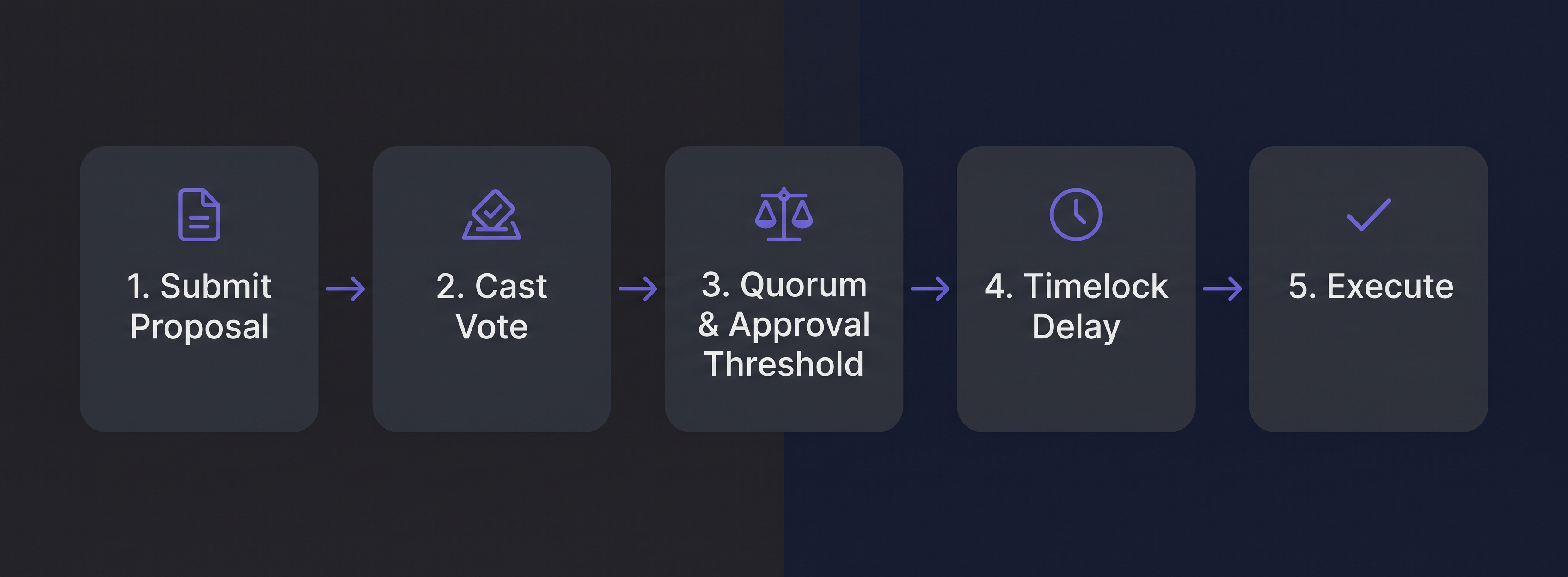
A robust governance process should include proposal submission, discussion, voting, quorum, approval threshold, timelock, execution and reporting. Critical upgrades should require testnet deployment, security review and validator readiness checks before execution.
Governance should be progressive. The foundation can operate critical launch functions through multisig during early mainnet, but governance should mature toward community-controlled treasury policy, transparent parameter changes and ecosystem grant programs.
| Governance Area | Examples of DAO Control |
|---|---|
| Treasury Spending | Grants, liquidity incentives, validator rewards and reserves |
| Validator Policy | Reward parameters, admission rules and performance requirements |
| Burn Policy | Real-time burn ratio and periodic burn formula |
| Protocol Upgrades | EVM upgrades, hard forks and infrastructure changes |
| RWA Policy | Issuer standards, compliance framework and approved asset categories |
12. RWA Tokenization Framework
DotOne RWA support includes real estate, commodities, precious metals, business assets, bonds, asset-backed instruments and enterprise assets. The network should support both open assets and permissioned assets because many RWA categories require investor eligibility checks, transfer restrictions and jurisdiction-specific controls.
RWA issuance should not be treated as simple token creation. Issuers may need legal wrappers, custody agreements, reserve attestations, KYC/AML flows, redemption rights, disclosure documents and role-based administrative controls. DotOne Wizard can automate deployment, but legal and compliance responsibility remains with issuers and regulated partners.
Important RWA smart contract capabilities include whitelist transfers, freeze or pause controls where legally required, identity registry hooks, metadata updates, asset lifecycle events, redemption modules, distribution rules and audit logs. These features should be optional and configurable by asset type.
| Asset Class | Supported Examples | Required Controls |
|---|---|---|
| Real Estate | Property ownership or income rights | KYC, legal wrapper, custody records |
| Commodities | Commodity-backed tokens | Reserve attestations and redemption logic |
| Precious Metals | Gold or silver-backed assets | Custody, audits and transfer rules |
| Business Assets | Receivables, invoices, revenue claims | Issuer diligence and risk disclosures |
| Bonds | Tokenized debt instruments | Investor eligibility and securities review |
| Enterprise Assets | Supply-chain or corporate assets | Permissioned transfer and access control |
13. DotOne Product Suite
DotScan at dotscan.one is the explorer and transparency layer. It should support transactions, addresses, contract verification, token pages, validator pages, bridge events, governance proposals and burn reporting. Explorer reliability is critical for exchanges, auditors and developers.
DotOne Swap at swap.dotone.online is a custom-developed DEX and not a PancakeSwap fork. This gives DotOne control over fee policy, liquidity incentives, RWA trading, cross-chain liquidity and DAO-managed parameters. The DEX should launch with core DOTO liquidity pairs and expand through governance-approved programs.
DotOne Wizard at wizard.dotone.online is a no-code asset issuance platform. It supports ERC-721, ERC-1155, future stablecoins and RWAs. It should include audited templates, deployment previews, metadata configuration, admin role management and optional compliance modules.
| Product | URL | Core Role |
|---|---|---|
| Explorer | dotscan.one | Transparency, verification, analytics and validator visibility |
| Bridge | bridge.dotone.online | Cross-chain asset movement and liquidity access |
| Swap | swap.dotone.online | Custom DEX for DOTO, DeFi and future RWA markets |
| Wizard | wizard.dotone.online | No-code asset issuance for NFTs, future stablecoins and RWAs |
| RPC | rpc.dotone.online / rpc2.dotone.online / rpc3.dotone.online | Public infrastructure and developer connectivity |
14. Bridge and Cross-Chain Strategy
The bridge roadmap starts with BNB Chain, expands to Ethereum, adds broader asset support, then connects Polygon, Arbitrum and Solana. The order reflects ecosystem compatibility, liquidity access and long-term multi-chain expansion.
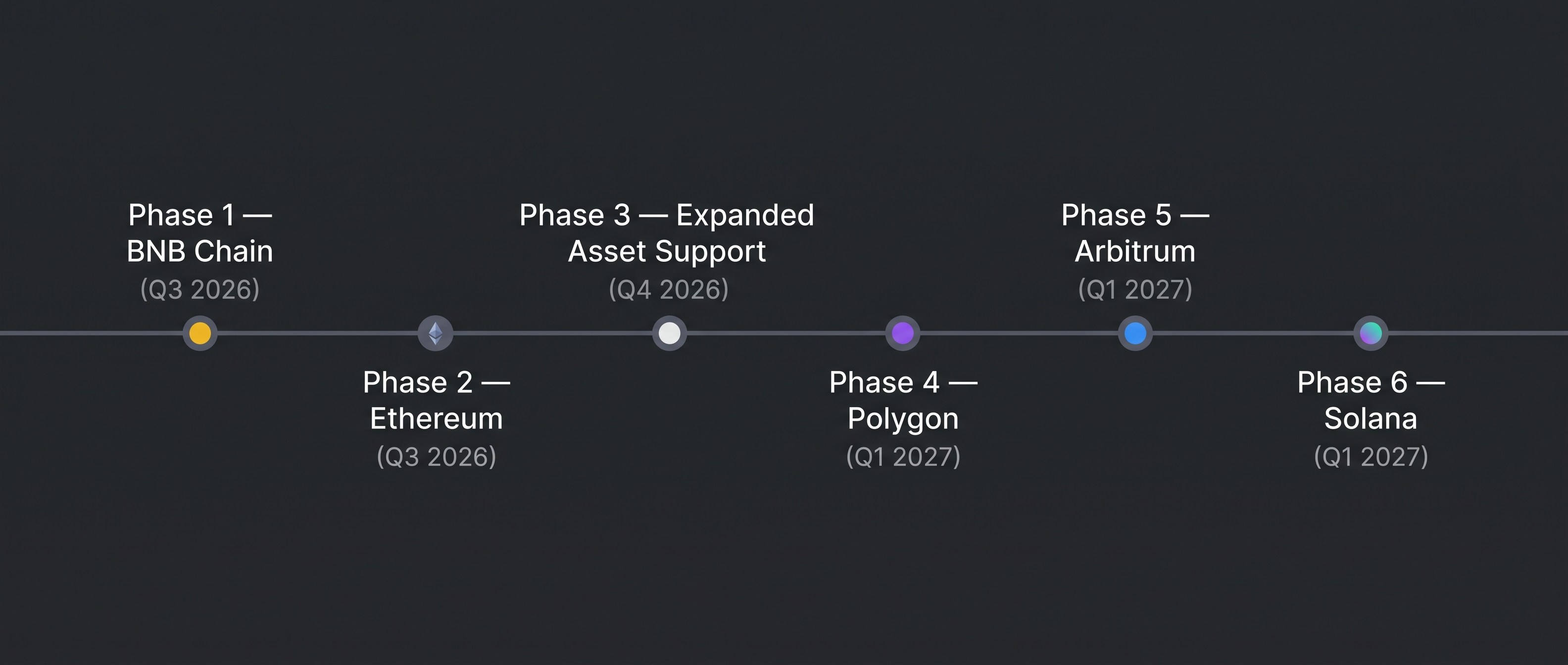
Bridge security is one of the highest-risk areas of the system. Requirements include independent audits, rate limits, asset accounting, proof or attestation logic, relayer monitoring, emergency pause, multisig/MPC controls, operational runbooks and incident communication plans.
The goal is not only token transfer. DotOne aims to support cross-chain liquidity, RWA distribution, stablecoin movement and enterprise settlement workflows. Bridge expansion should be gated by security readiness rather than marketing timelines.
| Bridge Phase | Target | Deadline |
|---|---|---|
| Phase 1 | BNB Chain | Q3 2026 |
| Phase 2 | Ethereum | Q3 2026 |
| Phase 3 | Expanded asset support | Q4 2026 |
| Phase 4 | Polygon | Q1 2027 |
| Phase 5 | Arbitrum | Q1 2027 |
| Phase 6 | Solana | Q1 2027 |
15. Security and Audits
Security controls include CertiK audit, bug bounty program, multisig treasury, validator hardening, smart contract reviews and continuous monitoring. Security scope includes protocol components, bridge contracts, treasury contracts, governance contracts, Swap, Wizard, RPC infrastructure, explorer and front-end domains.
Validator hardening should include secure key storage, sentry nodes, DDoS protection, patch management, monitoring, backups, access control and incident response. Validator admission should require evidence of operational capability before mainnet participation.
Smart contract security should include internal review, external audit, test coverage, static analysis, verification, admin key review and upgradeability assessment. Bridge and treasury contracts should be treated as critical infrastructure and require enhanced review.
| Security Domain | Required Controls |
|---|---|
| Protocol | Audit, testnet, monitoring and release management |
| Validators | Sentry nodes, key security, DDoS protection and patching |
| Treasury | 3-of-5 multisig, timelocks and reporting |
| Smart Contracts | Review, audit, verification and bug bounty |
| Bridge | Rate limits, emergency pause, monitoring and accounting checks |
| Front End | Domain security, release controls and phishing monitoring |
16. Operational Monitoring and Incident Response
DotOne should operate network monitoring from mainnet launch. Monitoring includes block production, validator uptime, RPC latency, peer connectivity, mempool health, bridge events, treasury transactions, burn execution, explorer indexing and governance contract activity.
Incident response should define severity levels, escalation contacts, decision authority, communication channels, emergency pause criteria and postmortem procedures. Bridge incidents, validator failures, chain halts and front-end compromises require specific runbooks.
Operational transparency builds trust. Public status pages, incident reports, validator performance dashboards and treasury activity reports should become standard ecosystem outputs.
| Operational Signal | Monitoring Objective |
|---|---|
| Block Time | Confirm stability around the 3-second target |
| Validator Uptime | Detect missed blocks and infrastructure failure |
| RPC Latency | Ensure developer and user reliability |
| Bridge Events | Identify abnormal transfer patterns |
| Treasury Transactions | Track governance and multisig execution |
| Burn Events | Verify real-time and periodic burn execution |
17. Ecosystem Growth Strategy
DotOne growth depends on developers, liquidity, validators, enterprises and community. Grants should prioritize infrastructure, DeFi primitives, RWA tools, wallets, analytics, compliance integrations and security tooling. Liquidity incentives should be measurable and time-bounded.
Developer onboarding should include documentation, hackathons, SDK examples, deployment templates, testnet support and technical support channels. Enterprise onboarding should include RWA templates, compliance partner introductions, private workshops and integration support.
Community development should focus on education, governance participation, validator transparency and ecosystem reporting. Sustainable growth requires high-quality applications rather than short-term speculative campaigns.
18. Roadmap
Q3 2026 includes mainnet, explorer, RPC infrastructure, validator network and BNB Bridge. Q4 2026 focuses on Swap expansion, liquidity programs and developer onboarding. Q1 2027 introduces DAO governance and treasury governance. Q2-Q3 2027 focuses on RWA infrastructure, compliance framework and institutional onboarding.
In 2028, DotOne expands toward Ethereum, Polygon and Arbitrum. In 2029, DotOne targets 100+ validators, enterprise adoption and a mature multi-chain ecosystem. Each phase should have launch criteria, security criteria and operational readiness criteria.
Roadmap changes should be communicated transparently. If a bridge or RWA feature is delayed for security or regulatory reasons, the delay should be treated as risk management rather than execution failure.
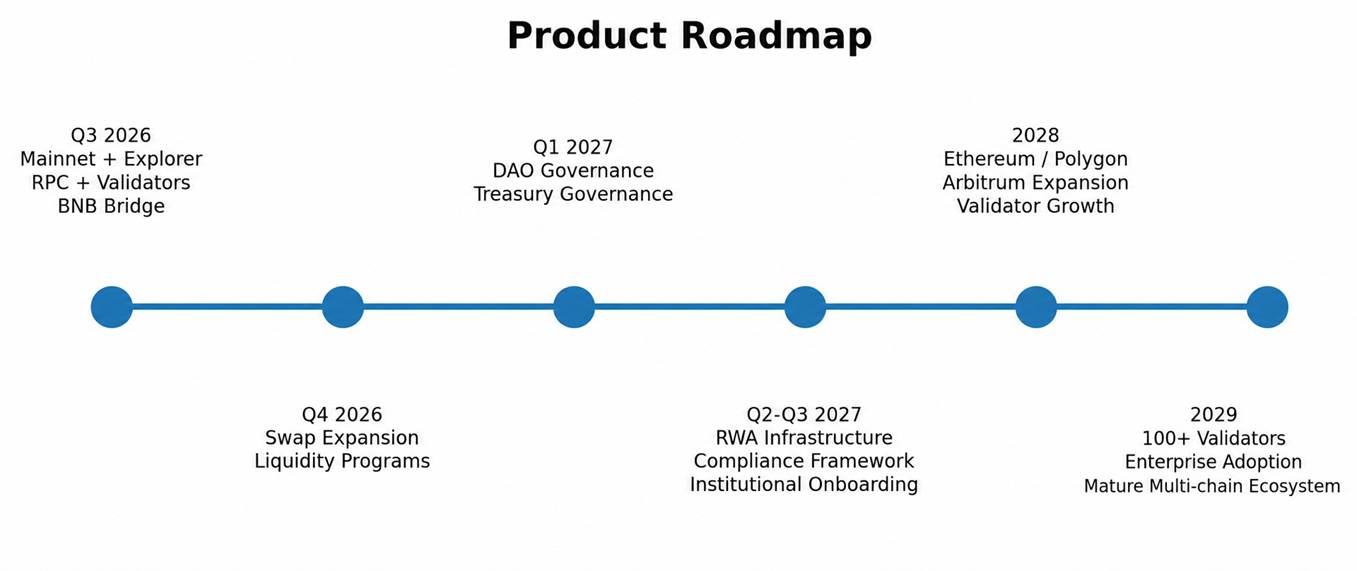
Figure 6. DotOne roadmap from mainnet to mature multi-chain ecosystem.
19. KPI Framework
DotOne should measure network health through both technical and economic KPIs. Technical KPIs include uptime, block time stability, RPC latency, validator participation, successful bridge transfers and smart contract deployment growth. Economic KPIs include TVL, DOTO liquidity, fee revenue, burn volume, treasury runway and grant ROI.
Governance KPIs include proposal participation, quorum success, execution timeliness, treasury reporting quality and validator participation in governance. RWA KPIs include issuer onboarding, compliant asset volume, redemption success and number of verified asset programs.
KPIs should be reported monthly or quarterly. Transparent metrics allow the community to evaluate whether treasury spending and governance decisions are creating measurable network value.
| KPI Category | Example Metrics |
|---|---|
| Network | Daily transactions, active addresses, block stability, RPC uptime |
| Validator | Validator count, missed blocks, geographic diversity, incidents |
| Economic | TVL, DOTO liquidity, fee revenue, burn volume, treasury runway |
| Developer | Contracts deployed, verified contracts, SDK usage, grants shipped |
| RWA | Verified issuers, compliant assets, redemption events, asset volume |
| Governance | Proposal count, voter participation, quorum and execution timeliness |
20. Risk Matrix
DotOne faces technical, economic, governance, regulatory and operational risks. The highest-risk areas are bridge security, validator centralization, smart contract vulnerabilities, regulatory uncertainty for RWA assets and treasury misallocation.
Risk mitigation requires staged deployment, audits, operational controls, DAO safeguards, multisig security, compliance review and public reporting. No single control is enough; DotOne should use layered defense across contracts, infrastructure, governance and operations.
Risk should be reviewed before every major phase: mainnet, bridge launch, DAO activation, RWA launch, cross-chain expansion and major treasury programs.
| Risk | Impact | Mitigation |
|---|---|---|
| Bridge exploit | High | Audits, limits, monitoring, emergency pause and phased rollout |
| Validator centralization | High | Validator expansion plan and transparent admission policy |
| Low network usage | Medium | Developer grants, liquidity programs and enterprise onboarding |
| Treasury depletion | High | Budget caps, reporting and DAO approval |
| Regulatory uncertainty | High | Jurisdiction-specific RWA controls and legal review |
| Governance capture | High | Quorum, timelocks, multisig safeguards and transparency |
| Smart contract vulnerability | High | Audit, bug bounty, verification and upgrade review |
21. Compliance Considerations
RWA compliance depends on jurisdiction and asset type. Some assets may require KYC/AML, investor accreditation, transfer restrictions, disclosures, regulated custodians or securities-law analysis. DotOne should provide compliance-capable infrastructure but should not represent that every token issued on the network is automatically compliant.
Stablecoins and asset-backed instruments require special attention. They may need reserve management, redemption procedures, attestation, issuer disclosures and jurisdiction-specific licensing. The Wizard should clearly distinguish technical issuance from legal authorization.
Governance should approve broad RWA standards and issuer categories only after legal and compliance review. Issuers should remain responsible for their asset documentation, investor onboarding and ongoing compliance obligations.
22. Conclusion
DotOne Smart Chain is designed as a BSC-inspired, EVM-compatible Layer-1 blockchain with fixed supply economics, PoS validators, DAO governance, treasury-based validator rewards, dual burn mechanisms and strong RWA orientation.
The project combines familiar developer tooling with a differentiated economic model: no inflation, disabled minting, no delegation at launch, transparent treasury use and governance-controlled network parameters. Its success will depend on secure implementation, disciplined treasury management, validator quality, liquidity growth and credible RWA adoption.
If executed carefully, DotOne can become a scalable settlement and tokenization layer for DeFi, enterprises and tokenized real-world assets while maintaining user-friendly EVM compatibility and a clear governance path.